New Patients
Patients can be seen for physical therapy both with and without a doctors
referral. However, many insurance companies require a referral and/or
authorization for treatment. It is recommended that you check with our office
or your insurance company regarding benefits.
referral. However, many insurance companies require a referral and/or
authorization for treatment. It is recommended that you check with our office
or your insurance company regarding benefits.
Prepare for your first appointment...
What to bring:
 | Doctor/Provider referral | |
| Insurance card | |
| Know the primary insurance holders date of birth | |
| Wear or bring loose clothes that allow for movement | |
| and expose the area you are seeking treatment for (IE. tanktops, sports bras, and shorts). Athletic shoes may also be needed for use of gym equipment. | ||
| Bring any information you might have with regards | |
| to your injury. (Imaging: x-rays, MRI) | ||
| Please download, print, and bring your new | |
| patient paperwork below. |
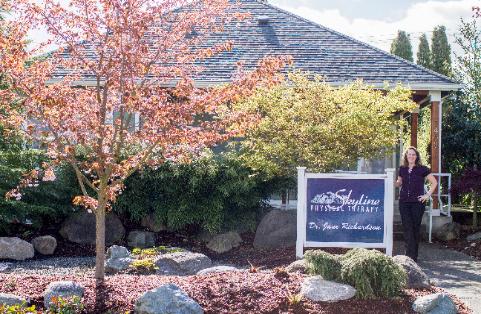
| Our office is located at 1408 N Garden Street. Parking for Skyline Physical Therapy is also available behind the office. Any space marked 1408 or is not marked behind 1404 is available for our patients. |
| Medical History | |
| Skyline's Policies & Procedures (Read and Sign) | |
| Registration Intake | |
| Functional Assessment | |

 | |  | |  | |  | |  | |  |

| Phone: 360.738.4300 Fax: 360.738.8010 1408 N. Garden St Bellingham, WA 98225 |
Before your appointment...
Please Download, Print, and BRING with you:
| 1408 N. Garden Street Bellingham, WA 98225 Phone: 360.738.4300 Fax: 360.738.8010 Click here to Email Us |
| | | | | | | | | | |


Horse Back Riding Tips:
Horseback riders can suffer
from a number of muscle
weaknesses. Physical therapy
can help identify these areas
and develop a individualized
plan to correct them. Jane has
been working with
equestrians of all ages for a
number of years and would
like to suggest a few tips.
Please note these are only
suggestions and all horseback
riding injuries should be
reviewed by a physical
therapist or your primary care
doctor.
Here are some points to
remember when working with
equestrians:
•A forward head posture is a
weakness in the neck flexors.
This is a cause of headaches
and a "wobble" head in riders.
•Rounded shoulders are due
to weak shoulder blade
muscles and make the rider
appear slumped in the saddle.
This position makes it difficult
and can lead to injuries or
muscle soreness.
•Tight chest muscles also
result in a slumped posture
and rounded shoulders (see
above).
•Riders need strong core
stability, which requires good
abdominal strength.
•The pelvis and lower back
must be flexible. These are
areas that frequently create
pain and stiffness in riders
(we see and treat a great
deal of lower back issues
among equestrians).
A high degree of fitness
decreases the chance of
serious injury, helps injuries
heal quickly, allows riders to
look more elegant in the
saddle, and makes riding more
enjoyable. In the event of an
injury, riders can look to
physical therapy to help them
"get back in the saddle again."
Horseback riders can suffer
from a number of muscle
weaknesses. Physical therapy
can help identify these areas
and develop a individualized
plan to correct them. Jane has
been working with
equestrians of all ages for a
number of years and would
like to suggest a few tips.
Please note these are only
suggestions and all horseback
riding injuries should be
reviewed by a physical
therapist or your primary care
doctor.
Here are some points to
remember when working with
equestrians:
•A forward head posture is a
weakness in the neck flexors.
This is a cause of headaches
and a "wobble" head in riders.
•Rounded shoulders are due
to weak shoulder blade
muscles and make the rider
appear slumped in the saddle.
This position makes it difficult
and can lead to injuries or
muscle soreness.
•Tight chest muscles also
result in a slumped posture
and rounded shoulders (see
above).
•Riders need strong core
stability, which requires good
abdominal strength.
•The pelvis and lower back
must be flexible. These are
areas that frequently create
pain and stiffness in riders
(we see and treat a great
deal of lower back issues
among equestrians).
A high degree of fitness
decreases the chance of
serious injury, helps injuries
heal quickly, allows riders to
look more elegant in the
saddle, and makes riding more
enjoyable. In the event of an
injury, riders can look to
physical therapy to help them
"get back in the saddle again."